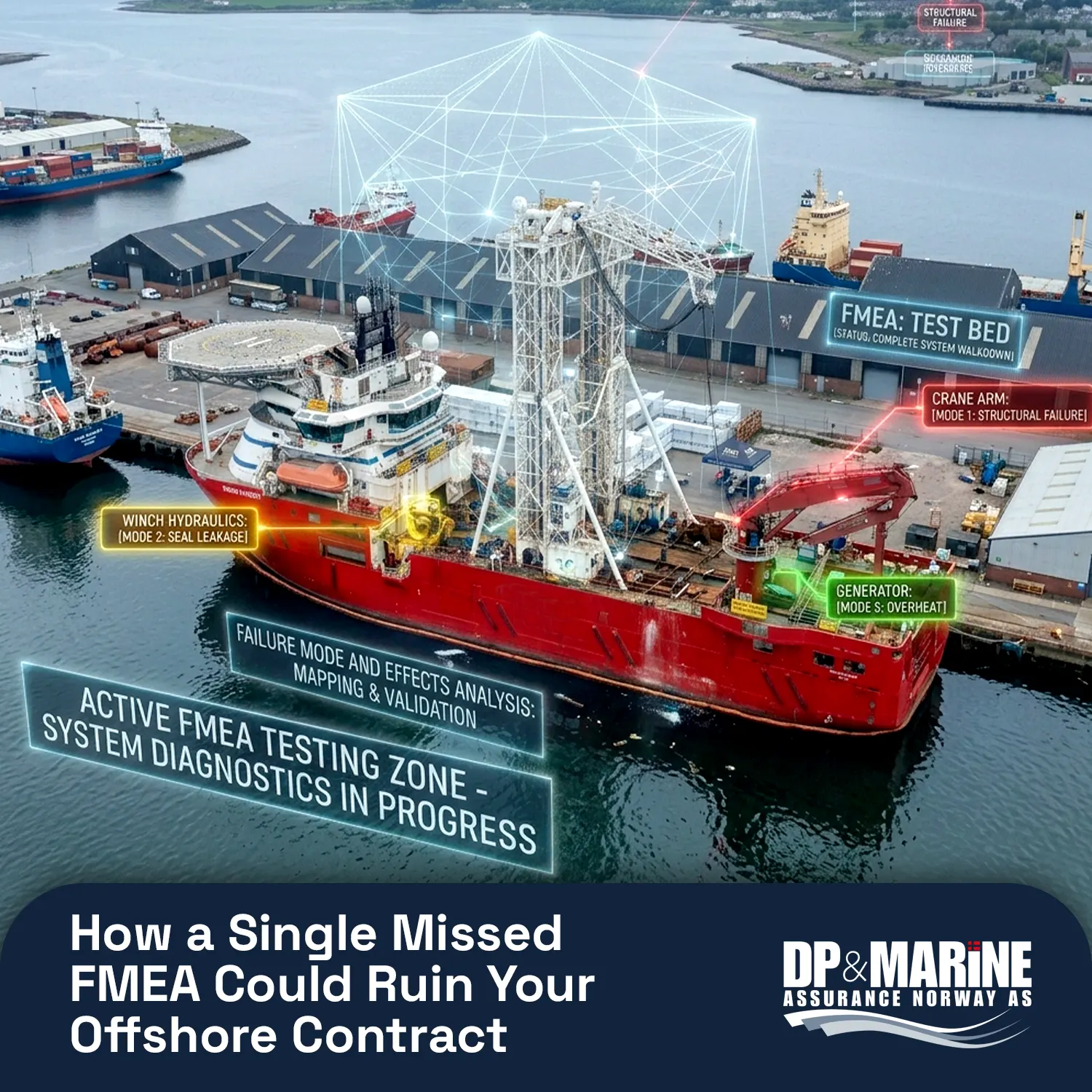
An offshore vessel can have the right DP notation, experienced crew and years of operational history, yet still face serious commercial risk if its Failure Modes and Effects Analysis (FMEA) is incomplete, outdated or has never been properly challenged.
For vessel owners and operators, an FMEA is far more than another technical document sitting in the vessel’s assurance file. It is a critical part of demonstrating that a vessel’s dynamic positioning system can withstand defined failures while maintaining the required level of operational safety and redundancy.
When charterers, clients and marine assurance teams scrutinise a vessel before mobilisation, weaknesses in the FMEA can quickly become weaknesses in the commercial proposition.
Could a missed FMEA failure mode be the reason your vessel loses its next offshore contract?
Your Vessel May Be Ready for Work. But Is Your FMEA?
Offshore contracts can involve significant financial commitments, tight mobilisation schedules and demanding technical requirements. Before a vessel is accepted, clients may review its DP documentation, FMEA, proving trials, annual trials, incident history and wider marine assurance records.
This means that technical documentation can directly influence commercial decisions.
An FMEA that was produced several years ago may no longer accurately represent the vessel’s current configuration. Equipment may have been replaced, software updated, switchboards modified, thrusters upgraded or control systems changed.
Yet the original FMEA may still be sitting in the vessel’s documentation package.
That creates a potentially serious disconnect between what the FMEA says the vessel can do and what the vessel is actually capable of doing today.
What Happens When a Charterer Finds an FMEA Weakness?
The commercial consequences can be significant.
A charterer or marine assurance team discovering an unexplained failure mode, inadequate consequence analysis or inconsistency between the FMEA and the vessel’s current configuration may request additional information, further testing or corrective action before accepting the vessel.
In a worst-case scenario, mobilisation can be delayed while technical issues are investigated and resolved.
For an offshore vessel working against a demanding project schedule, even a relatively small delay can have substantial financial consequences.
Potential Commercial Consequences
- Delayed vessel mobilisation
- Additional testing and engineering costs
- Off-hire exposure
- Contractual penalties
- Loss of client confidence
- Additional marine assurance requirements
- Potential loss of the contract
The cost of identifying an FMEA weakness before mobilisation is usually considerably lower than discovering it when a client is already waiting for the vessel to commence operations.
The Problem With an FMEA That Has Never Been Properly Challenged
An FMEA is only useful if it accurately identifies the credible failure modes that could affect the vessel’s ability to maintain position and continue safe operations.
Simply having an FMEA document does not automatically demonstrate that every relevant failure scenario has been properly considered.
Independent review can challenge assumptions, identify gaps and determine whether the documented failure modes accurately reflect the vessel’s present-day systems.
Common Areas That May Require Closer Examination
These can include power generation and distribution, propulsion and thruster systems, DP control systems, power management systems, switchboards, auxiliary systems, control networks, sensors, communications and interfaces between critical systems.
The objective is not simply to find faults in documentation. It is to determine whether the vessel’s stated redundancy and worst-case failure assumptions remain credible.
Your Vessel Has Changed. Has Your FMEA Changed With It?
This is one of the most important questions vessel operators should ask.
Modern offshore vessels rarely remain completely unchanged throughout their operational life. Equipment is upgraded. Components are replaced. Software is updated. Electrical systems are modified. Thrusters are overhauled. Automation systems evolve.
Every significant modification has the potential to affect the assumptions contained within the original FMEA.
If the vessel changes but the FMEA does not, the documentation can gradually become an inaccurate representation of the vessel.
When Should an FMEA Be Reviewed?
An FMEA review should be considered following significant modifications to critical systems, major equipment replacement, control system upgrades, changes to the vessel’s operational profile or when concerns are identified during trials, incidents, audits or marine assurance inspections.
Regular independent review can also provide valuable reassurance that the FMEA remains aligned with the vessel’s current configuration and operational requirements.
The Hidden Risk: Failure Modes That Were Never Considered
One of the biggest dangers is not necessarily a failure mode that has been incorrectly documented. It is the failure mode that was never identified in the first place.
Complex DP vessels contain multiple interconnected systems. A failure in one system can potentially affect another, creating consequences that may not be obvious when individual components are considered in isolation.
This is why a robust FMEA needs to consider not only individual component failures but also interactions, dependencies, common-mode failures and credible combinations of failures.
The question is not simply “What can fail?”
The more important question is “What happens to the vessel when it fails?”
Why Independent FMEA Validation Matters
An independent FMEA review provides a fresh technical perspective that can challenge existing assumptions without being influenced by the original design or documentation process.
At DP & Marine Assurance Norway AS, independent assessment can help vessel owners and operators identify weaknesses before those weaknesses become operational or commercial problems.
Our approach focuses on understanding the vessel as an integrated system rather than treating the FMEA as a standalone document.
From Documentation to Demonstrated Capability
The most valuable assurance comes from connecting what is documented in the FMEA with what can actually be demonstrated through testing and trials.
This can include reviewing failure scenarios, examining system responses and assessing whether the vessel’s redundancy assumptions are supported by practical evidence.
Could Your Vessel Pass an Independent FMEA Challenge?
Imagine a charterer’s technical team asking a simple question:
“Show us what happens if this critical system fails.”
Would your FMEA provide a clear and defensible answer?
Could your crew demonstrate the expected response?
Does the DP system behave exactly as the FMEA predicts?
Are the vessel’s worst-case failure assumptions supported by testing?
If there is uncertainty surrounding any of these questions, it may be time for an independent FMEA review.
Don’t Wait Until a Charterer Finds the Problem
One of the biggest advantages of proactive marine assurance is timing.
Finding a technical weakness while the vessel is available for investigation and corrective action is very different from discovering the same weakness days before mobilisation.
When a vessel is under commercial pressure to sail, every additional day can become expensive.
By conducting an independent review before the vessel enters a critical campaign, operators have an opportunity to identify issues, investigate their causes and implement corrective measures without a charterer standing over the process.
Find the problem before your client does.
FMEA Review for Offshore Vessels
DP & Marine Assurance Norway AS provides specialist marine assurance and dynamic positioning services designed to help vessel owners and operators understand, verify and manage operational risk.
Our FMEA-related services can support vessels throughout their operational lifecycle, from newbuild and commissioning through to established offshore vessels undergoing upgrades, modifications or changes in operational requirements.
Our FMEA Assurance Approach
- Independent FMEA review
- Failure mode assessment
- Redundancy analysis
- Worst-case failure assessment
- Consequence analysis review
- DP system integration assessment
- Review of vessel modifications and system changes
- Support with proving trials and failure scenario testing
The objective is to provide vessel operators with a clearer understanding of their actual DP resilience and help ensure that their technical documentation remains aligned with the vessel’s current configuration.
Protect Your Next Offshore Contract Before It Is Too Late
Your next offshore contract could be worth millions. The cost of proactively reviewing an FMEA is small compared with the potential commercial impact of mobilisation delays, technical findings or vessel rejection.
Don’t assume that an old FMEA is still good enough.
Don’t wait for a charterer’s marine assurance team to identify a weakness.
And don’t rely on documentation that may no longer represent your vessel’s actual configuration.
Challenge Your FMEA Before Someone Else Does
DP & Marine Assurance Norway AS can provide independent FMEA review, DP assurance and failure scenario assessment to help vessel owners and operators identify potential weaknesses before they affect offshore operations.
Find the gap. Fix the risk. Protect the contract.
Contact DP & Marine Assurance Norway AS today to discuss an independent FMEA review for your vessel.
Frequently Asked Questions About DP FMEA
What is a DP FMEA?
A DP FMEA examines how failures within a vessel’s dynamic positioning-related systems could affect its ability to maintain position and identifies the consequences of those failures.
Why should a DP FMEA be independently reviewed?
Independent review provides an additional level of technical scrutiny and can identify gaps, inconsistencies or assumptions that may not have been challenged during the original FMEA process.
How often should a DP FMEA be reviewed?
The appropriate review frequency depends on the vessel, its configuration, operational profile, modifications and applicable requirements. A review should be considered whenever significant changes could affect the original FMEA assumptions.
Can an outdated FMEA affect an offshore contract?
Yes. If a charterer or marine assurance team identifies discrepancies between the FMEA, the vessel’s current configuration and demonstrated performance, additional investigation or corrective action may be required before the vessel is accepted for an offshore campaign.
Can DP & Marine Assurance Norway AS review our existing FMEA?
Yes. Independent FMEA review and wider DP assurance can help vessel owners and operators assess whether their existing documentation remains appropriate for the vessel’s current configuration and operational requirements.