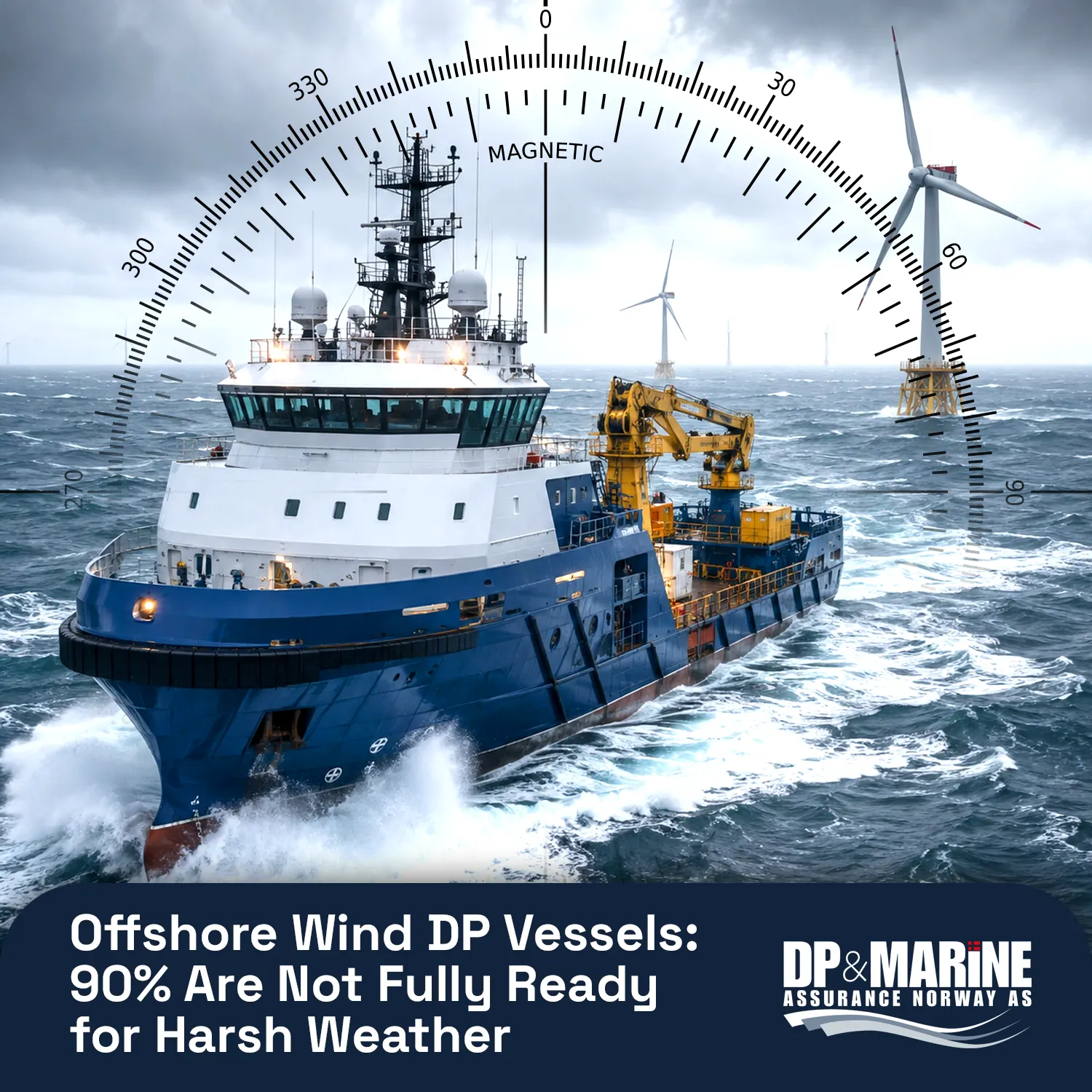
Offshore wind is expanding rapidly — but is your Dynamic Positioning system ready for the conditions it will actually face?
As offshore wind projects move further offshore and into increasingly demanding environments, Dynamic Positioning (DP) vessels are being asked to maintain precise position and heading in conditions where wind, waves, currents and vessel loads can combine to create significant operational challenges.
A vessel may have DP2 or DP3 notation, a completed FMEA and a history of successful operations. But that does not automatically mean its DP capability has been adequately challenged for the specific conditions of an offshore wind campaign.
The question is not simply whether your vessel is DP compliant. The question is whether its DP capability has been properly tested against the conditions it is expected to operate in.
Could Your DP Vessel Be Less Prepared Than You Think?
Offshore wind operations can place very different demands on a vessel compared with traditional offshore activities. Cable installation, turbine maintenance, foundation work, construction support, walk-to-work operations and heavy lifting can all create demanding DP requirements.
Weather windows can be narrow, mobilisation costs can be substantial and vessel downtime can have a direct commercial impact on the entire project.
A DP system that performs well during routine operations may respond very differently when exposed to high environmental loads, changing vessel configurations, simultaneous operations or equipment failures.
Certification Does Not Replace Operational Assurance
DP notation provides an important foundation, but certification alone does not demonstrate that every operational scenario has been adequately considered.
Independent DP assurance can provide an additional layer of confidence by examining the vessel’s actual capability, redundancy philosophy, failure scenarios, operational limitations and supporting documentation.
Why Harsh Weather Can Expose Hidden DP Weaknesses
Strong winds, heavy seas and significant currents increase the environmental forces acting on a vessel. The DP system must compensate for these forces while maintaining position and heading — potentially while the vessel is also carrying out complex offshore work.
This becomes particularly important when the vessel is operating close to offshore structures, wind turbines, substations or other assets where even a relatively small loss of position can have serious consequences.
The Combined Effect of Wind, Waves and Current
Environmental conditions rarely occur in isolation. Wind direction can change, current can vary and wave conditions can introduce additional forces and vessel motion.
Understanding how these factors interact with available thruster capacity, power generation and DP control is therefore critical when assessing operational capability.
What Happens When Equipment Fails?
Harsh-weather assurance should not only consider normal operation. A properly structured assessment should consider credible failure scenarios and determine whether the vessel can maintain the required level of capability following a failure.
This is where DP FMEA verification, consequence analysis and proving trials become particularly valuable.
Is Your DP FMEA Telling the Whole Story?
The DP FMEA is a fundamental component of DP assurance, but an FMEA is only as useful as its accuracy, completeness and relationship to the vessel’s current configuration.
Vessels evolve. Equipment is replaced, software is updated, electrical systems are modified and operational profiles change. An FMEA that accurately represented the vessel several years ago may no longer provide the same level of assurance today.
When Was Your DP FMEA Last Independently Challenged?
An independent review can identify discrepancies between documented failure scenarios and the vessel’s actual configuration and operation.
It can also help determine whether assumptions surrounding redundancy, power generation, thruster availability and worst-case failure scenarios remain appropriate.
If your vessel has changed, your DP assurance should change with it.
Offshore Wind Operators Cannot Afford Unexpected DP Downtime
Offshore wind projects operate against demanding commercial schedules. Delays can affect vessel availability, turbine installation, maintenance programmes, personnel movements and wider project milestones.
A DP-related problem offshore can therefore become much more than a technical issue. It can become a commercial problem.
The Cost of a DP Failure Goes Beyond the Vessel
A loss of position or unexpected operational restriction can potentially result in downtime, standby costs, schedule disruption, additional vessel requirements and contractual complications.
For high-value offshore campaigns, the cost of proactive assurance can be insignificant compared with the potential financial consequences of discovering a weakness after mobilisation.
Independent assurance is not simply another offshore cost. It is an investment in operational continuity.
What Should Offshore Wind Operators Be Testing?
Every vessel and operation is different, which is why DP assurance should be based on the vessel’s configuration, intended operation and environmental conditions rather than a generic checklist.
DP System Performance
Assessing the performance of the DP system under representative operating conditions can help establish whether the vessel is capable of maintaining the required position and heading within its operational limitations.
Power Generation and Distribution
Power availability is fundamental to DP capability. Assurance should consider the interaction between generators, switchboards, power management systems and DP systems, including relevant failure scenarios.
Thruster Capability
Available thrust and thruster configuration are critical when operating in challenging environmental conditions. Assessing the vessel’s actual capability can help identify potential limitations before they become operational problems.
Worst-Case Failure Scenarios
Testing and analysis should demonstrate whether the vessel can maintain the required capability following defined credible failures and whether the documented worst-case failure assumptions remain valid.
Could Your Vessel Pass a DP Stress Test?
This is the question offshore wind operators should be asking before the vessel arrives at the project.
Rather than discovering limitations during a demanding offshore campaign, operators can proactively assess the vessel’s DP capability before mobilisation.
Independent DP assurance can provide a structured examination of the vessel, its systems, documentation and operational capability — helping identify weaknesses while there is still time to address them.
Find the Weakness Before the Weather Does
The most expensive time to discover a DP limitation is when your vessel is already offshore, your project is underway and your weather window is closing.
Proactive testing gives vessel owners and offshore wind contractors the opportunity to identify, investigate and rectify potential problems before they affect the operation.
Independent DP & Marine Assurance for Offshore Wind
DP & Marine Assurance Norway AS provides specialist Dynamic Positioning and Marine Assurance services for demanding offshore operations.
Our approach is focused on more than simply confirming that documentation exists. We examine the relationship between the vessel, its DP systems, its operational profile and the risks associated with the intended operation.
Whether you are preparing a vessel for an offshore wind contract, planning a major campaign, completing annual DP trials or seeking an independent review of your DP assurance documentation, specialist support can provide valuable additional confidence before mobilisation.
Services Can Include
DP assurance, DP FMEA review, FMEA proving trials, DP annual trials, consequence analysis, DP system assessment, vessel assurance, marine assurance and independent technical consultancy can all form part of a risk-based assurance programme.
The exact scope should be developed around the vessel, project requirements and operational environment.
Don’t Wait for a DP Failure to Tell You Your Vessel Wasn’t Ready
Offshore wind is pushing vessels into increasingly demanding operational environments. The margin for unexpected downtime is becoming smaller, while the commercial consequences of disruption can become increasingly significant.
Your vessel may be certified. Your DP system may have passed its previous trials. Your FMEA may be on file.
But when was the last time someone independently challenged whether your vessel is genuinely ready for the conditions it will face offshore?
Don’t wait until the weather deteriorates, the vessel is under pressure and the project is counting on you.
Put Your DP Capability to the Test Before Your Next Offshore Wind Campaign
Contact DP & Marine Assurance Norway AS to discuss an independent DP assurance assessment, FMEA review, proving trial or marine assurance requirement for your offshore wind operation.
Find the weakness before the operation does.
Contact DP & Marine Assurance Norway AS today and make sure your vessel is ready for the conditions that matter.
Offshore Wind DP Assurance: Are You Ready?
If your vessel is preparing for offshore wind operations, don’t rely solely on historic performance or paperwork. Get an independent assessment of your DP capability and identify potential risks before they become costly offshore problems.
Talk to the DP specialists at DP & Marine Assurance Norway AS today.