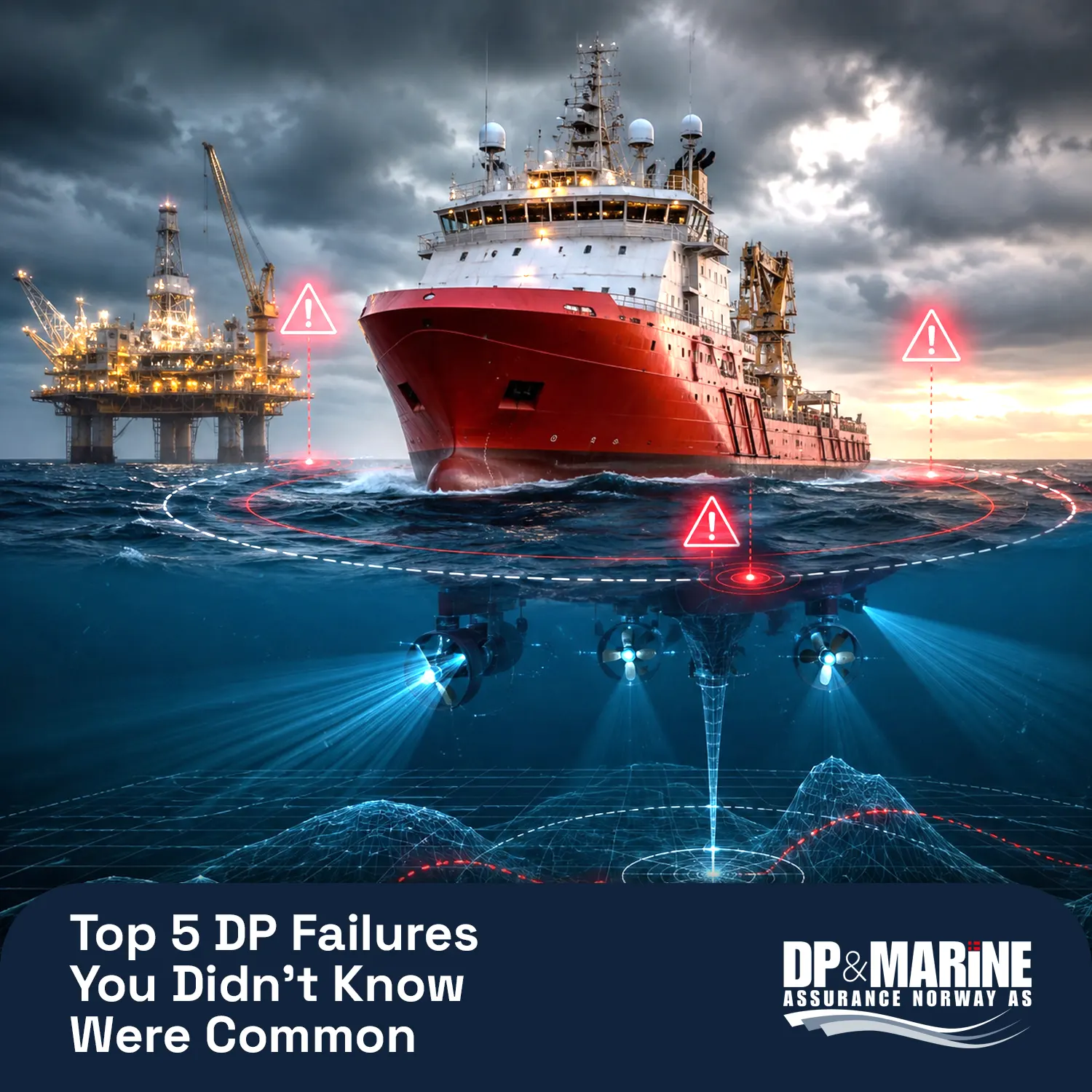
The Hidden Dynamic Positioning Risks That Are Quietly Putting Offshore Vessels at Risk
Most DP vessels operate under a dangerous assumption: if it passed its DP trials, it must be safe. In reality, many critical failure modes remain undetected until operations are underway offshore.
These are not catastrophic headline failures — they are subtle, repeatable, and commercially damaging issues that often go unnoticed until it is too late.
Below are the top 5 DP failures that are far more common than most operators realise:
1. Hidden Thruster Interaction Loss (The Silent Efficiency Killer)
What is happening?
Thrusters may perform correctly in isolation, but when operating together under load, interaction effects can reduce total DP capability.
Why this matters
- Vessel appears fully compliant during trials
- Reduced station-keeping performance in real conditions
- Only becomes visible in harsh weather or high load scenarios
Operational risk
This can result in degraded positioning performance when vessels are operating near their environmental limits.
Commercial impact
Unexpected loss of efficiency can lead to increased fuel use, reduced operational window, and potential off-hire risk.
2. Power Management “False Redundancy”
What is happening?
Systems appear redundant on paper, but Power Management System (PMS) logic creates hidden dependencies between generators and switchboards.
Why this matters
- Breaker logic may not isolate failures as expected
- Load sharing may introduce shared vulnerability
- Auxiliary systems may create hidden coupling effects
Operational risk
A single fault can cascade across systems assumed to be independent.
Commercial impact
This can compromise DP redundancy assumptions and increase exposure during critical offshore operations.
3. Gyro and Position Reference Drift Misalignment
What is happening?
Multiple position reference systems may slowly diverge without immediate alarm conditions.
Why this matters
- DP system continues operating on inaccurate data
- Small deviations accumulate over time
- Increased thruster activity to correct false offsets
Operational risk
Positioning decisions are made using degraded or misaligned reference data.
Commercial impact
Higher fuel consumption, reduced efficiency, and increased risk during precision operations such as diving or subsea construction.
4. Weather Envelope Overestimation (The Overconfidence Problem)
What is happening?
Operational limits are often based on ideal conditions and do not fully account for degraded system performance.
Why this matters
- Actual safe operating window is smaller under failure conditions
- Environmental loads are underestimated in degraded modes
- Operational planning may be overly optimistic
Operational risk
Vessels may operate closer to failure thresholds than realised by operators.
Commercial impact
Unexpected downtime, aborted operations, and increased exposure during harsh weather campaigns.
5. Mode Change Instability During Critical Operations
What is happening?
Transitions between DP modes (auto, joystick, manual, transit) may introduce transient instability under load.
Why this matters
- Short-term thrust imbalance during switching
- Heading instability or positional drift
- Delayed system response under stress
Operational risk
Instability during critical transitions such as emergency response or system recovery.
Commercial impact
Increased risk during high-value operations where precision control is essential.
Why These Failures Are Often Missed
Standard testing limitations
Most DP trials and inspections focus on compliance rather than real-world system interaction under stress conditions.
What is often overlooked
- System interaction effects
- Degraded operational modes
- Edge-case environmental conditions
- Transient system behaviour
These gaps are where operational risk is most likely to exist.
The Commercial Reality of DP Weaknesses
These issues rarely cause immediate system failure — but they frequently result in:
- Off-hire periods
- Reduced charter confidence
- Increased insurance scrutiny
- Operational inefficiency
- Failed audits or conditional acceptance
Small DP weaknesses can become significant commercial losses offshore.
How DP & Marine Assurance Norway AS Can Help
Independent DP Assurance Services
- DP FMEA validation and review
- DP Annual Trial witnessing
- Pre-CMID gap analysis and readiness reviews
- Worst-case failure design intent verification
- Operational risk and consequence analysis
We identify and address hidden DP vulnerabilities before they become operational or contractual issues.
Book a DP Assurance Review
If your vessel has only passed standard DP trials, it may not have been fully tested under real operational stress conditions.
Before your next offshore campaign or charter, ensure your DP system is fully proven — not just certified.
Contact DP & Marine Assurance Norway AS to schedule an independent review.